A Gay Agenda for Scripture: Biblical Hermeneutics Through Feminist and Queer Theology

Religious persecution against LGBTQ+ (lesbian, gay, bisexual, trans, and queer) individuals due to understandings of sexual morality derived from interpretations of the Bible and church teachings. Feminists looking to truly practice intersection feminism and liberation theology will apply multiple axes of thinking to understand the complexities of LGBTQ+ people who are also Christian. Queer theology reclaims gender nonconformity and queer sexuality as part of the lived human experience and history, and questions the social and cultural norms that are assumed and applied within theology.[1] To be inclusive of sexual and gender identities, queer theology allows LGBTQ+ people to reclaim their faith traditions through processes called “queering the Bible” and “queering God.” Through contextualizing the Bible and historical criticism, queer theologians position Scripture within the time and place it was written and consider how over time translations, human interaction, and institutions of power have turned the Bible into an instrument of oppression against LGBTQ+ individuals and other minorities. Intersectional theology does not only seek to proclaim they have found the ultimate truths of the Bible, but “destabilizes fixed notions of theological truth by offering multiple and competing statements of experience and understanding across and within differences and evaluating those statements through a lens of justice.”[2] Practices of queering the Bible include taking what is known as “clobber verses” and understanding how they are either misquoted, taken out of context, or have nothing to do with the question of homosexuality but have been used as proof of homosexuality as a sin. Queer theologians will also take other passages and reinterpret them through a queer affirming lens to show how despite the verses that condemn same-sex relationships, there are others that support queer people. Queer womanist theologians as well have called on reinterpretations of Biblical texts and specifically through the reorganizing churches and leadership to reflect intersectionalities of people of color with the LGBTQ+ community.[3] Through feminist theological methodologies of practicing intersectionality through an inclusive vision, theologies of gender egalitarianism, and redefining sin queer theologians have chosen paths of reinterpreting Biblical verses or stories to create affirming narratives.
Clobber Passages and Mistranslations: Queer Theologians Elizabeth Stuart, Rev. Dr. Nancy Wilson, Rev. Mona West, and Ed Oxford
The clobber passages most referenced include Genesis 19, Leviticus 18:22 and 20:13 in the Old Testament and Romans 1:26-27, 1 Corinthians 6:9, and 1 Timothy 1:10. Elizabeth Stuart, Rev. Dr. Nancy Wilson, and Rev. Mona West are leading queer feminist theologians who have taken on the task of applying queer readings to the Bible. As a lesbian feminist theologian, Stuart has identified the heterosexual biases within Scriptures, Christian theology, and specifically the gendered understanding of women’s relationships best symbolized by the tradition that identified the church as the bride of Christ.[4] For West, the Old Testament and Hebrew Scripture are her subjects of research. Specifically, the story of Sodom and Gomorrah in Genesis 19 has been used as evidence that God was against men wanting to engage in same-sex behavior, when in fact the story is about threatening gang rape.[5] The reason why God destroyed Sodom and Gomorrah is revisited in Ezekiel 16:49, which clarifies “Now this was the sin of your sister Sodom: She and her daughters were arrogant, overfed and unconcerned; they did not help the poor and needy.”[6] The threat of same-sex rape or gang rape is not equivalent to the consensual queer relationships today that are based on mutuality and commitment. The earliest Christians read the Sodom story as a parable about inhospitality, arrogance, and violence, not same-sex behavior.[7] In Leviticus 18:22, male same-sex intercourse is prohibited, and violators are given the death penalty: “Thou shalt not lie with mankind, as with womankind; it is abomination.”[8] The defense of homophobia with Leviticus is not only non-affirming but non-Christian, as the New Testament teaches that Christ’s death and resurrection fulfilled the law. The prohibitions in Leviticus do not apply to Christians, and they are rooted in cultural gender roles. The prohibitions against male same-sex relations were part of the moral law that categorizes acts as “abominations” for which the death penalty would be the punishment. There are widely accepted practices of charging interest on loans (Ezekiel 18:13), burning incense (Isaiah 1:13), and eating pork, rabbit, and shellfish (Deuteronomy 14:3-21), all of which are called abominations. Charging interest on loans and working on the Sabbath is acceptable (Exodus 35:2) but the death penalty is not applied today as it is in these passages. The New Testament contains the longest passage on same-sex relations: “Because of this, God gave them over to shameful lusts. Even their women exchanged natural sexual relations for unnatural ones. In the same way, the men also abandoned natural relations with women and were inflamed with lust for one another. Men committed shameful acts with other men and received in themselves the due penalty for their error.” (Romans 1:26-27) Paul’s words here are negative, but the actions he condemns are lustful and make no mention of love, commitment, or faithfulness which are seen in the reality of same-sex relationships. Paul’s words of “shameful,” “exchanged,” and “abandoned,” show that this scenario went beyond the healthy, committed same-sex relationships that exist today.
Queering the Bible Through Tracking the Translations: The Word “Homosexual” is NOT in the Bible
Queer theologians, coming from the same branch of feminist liberation theology, see Scripture as targeting the sin of lust of a sin of excess and indulgence, not of finding a loving relationship built on mutuality and love. Same-sex behavior in the ancient world which Christianity was rebelling against was isolated to the practices of lustful self-indulgence and pederasty, the sexual practice of older men having sexual relationships with younger boys, either as their slaves, or students, or prostitutes. While Paul labels same-sex relationships “unnatural” he says in 1 Corinthians 11:14, that for men to wear their hair long also goes against nature, and most Christians see that as adherence to cultural conventions.[9] In 1 Corinthians 6:9 and 1 Timothy 1:10, two Greek words, malakoi and arsenokoitai, are included in lists of people who will not inherit the kingdom of God.[10] These terms have been interpreted to mean homosexual and men who have sex with men respectively, to become sweeping statements about gay people. The term malakoi literally means “soft,” and it was widely used to describe a lack of self-control, weakness, cowardice, and laziness.[11] Given that those negative characteristics were, unfortunately (and unfairly) attributed to women in the ancient world, the term was also long translated as effeminate. It’s only in the past century that many Bible translators have connected the word specifically to same-sex relationships. More common English translations in past centuries were terms such as “weaklings,” “wantons,” and “debauchers.” The term arsenokoites (the singular form) comes from two Greek words: arsen, meaning “male,” and koites, meaning “bed.”[12] Those words appear together in the Greek translation of Leviticus 20:13, leading some to speculate that Paul coined the term arsenokoites in order to condemn same-sex behavior. By analyzing other contexts in which arsenokoites has been used in other contexts by Paul, which are shown to indicate the word related to sexual or economic exploitation, again not about the sexual orientation of loving, queer relationships. The translation of these terms into explicitly meaning “homosexual” did not come into modern translations of the New Testament until 1946 and not in the Old Testament until 1952 with the RSV translations.[13] Gay theologian Ed Oxford is doing the most current research on the translation, and started with German Bibles from the 1800s and found in Leviticus 18:22 translates to “Man shall not lie with young boys as he does with a woman, for it is an abomination” and Leviticus 20:13 uses the term “young boys” as well. For 1 Corinthians, the German Bible translated the passage with arsenokoites as “boy molesters” will not inherit the kingdom of God, which was translated the same in Martin Luther’s original German translation from 1534. The word “homosexual” did not appear in German translations until 1983.[14] The same mistranslations have been found in a 1674 Swedish translation and an 1890 Norwegian translation of the Bible. Oxford concluded that four of the six clobber passages, these translations from all the major European languages were referring to pederasty, and not the sexual orientation of homosexuality and being queer.[15] However, the concept of sexual orientation did not even exist in the ancient world how it is understood today. The strict class and gender hierarchies of ancient societies understood relationships based on dominance and patriarchal gender roles. For their understanding, sexual identity was not defined by sexual orientation, but by these patriarchal gender roles which view men who were dominant in sex more positively, regardless of if their partners were men or women. There is no question that Paul did not take a positive position on same-sex relationships, but he was also writing from a perspective where he believed no one should get married and he was writing in a context that is incredibly different than the world today where LGBTQ+ people are in committed, monogamous relationships. The Bible never addresses the issue of sexual orientation or same-sex marriage, and the passages used to justify discrimination, violence, and oppression of LGBTQ+ individuals because of Biblical precedent is unfounded when these verses are analyzed through queer theology.
Finding Affirming Narratives by Queering Same-Sex Relationships:
David and Jonathan & Ruth and Naomi
Another approach to biblical hermeneutics is not just in reinterpreting translations but in seeking out clearly affirming passages and Biblical stories. Queer theologians turn to Paul in Galatians 3:28: “There is neither Jew nor Gentile, neither slave nor free, nor is there male and female, for we are all one in Christ Jesus.”[16] This challenge to the gender binary has allowed queer Christians to have an all-encompassing Biblical verse that non-affirming Christians see Leviticus and Corinthians stand for. Queer theologians have not had a lack of Biblical stories with representations of same-sex relationships that show companionship, love, mutuality, and affection. The queer hermeneutical task works to liberate subtext, particularly with the stories of David and Jonathan (in 1 Samuel) and Ruth and Naomi (in the Book of Ruth). The story of David and Jonathan is filled with mentions of how David’s beauty attracted Saul, how much Saul loved David (1 Samuel 16:4-23), and evolves to how the love between David and Jonathan. Jonathan was willing to give up his inheritance to the crown for David (1 Samuel 18:1-4; 20:30-34). Rev. Dr. Wilson describes the first meeting between Jonathan and David as “explicitly homoerotic.” [17] Returning to 1 Samuel, “When David had finished speaking to Saul, the soul of Jonathan was bound to the soul of David, and Jonathan loved him as his own soul… Then Jonathan made a covenant with David because he loved him as his own soul.” (1 Samuel 18:1-3) The nature of the relationship is heightened a few passages further, “David rose from beside the stone heap and prostrated himself with his face on the ground. He bowed three times, and they kissed each other, and wept with each other. David wept the more. (1 Samuel 20:41) Wilson argues that despite translation annotations in the NRSV, earlier translations of the RSV have translated the final line as “until David recovered himself” or how he was “overcome,” possibly a euphemism for passion, or even sexual arousal for some theologians.[18] Stuart analyzes the Hebrew manuscripts to make the claim that the NRSV’s version uses higdil rather than ‘ad hagdël, which in Greek is heōs tēs synteleias, meaning “until the ejaculation” and may refer to David as “growing large.”[19] In 2 Samuel, David acknowledges his deep love for Jonathan, as “greatly beloved were you to me; your love to me was wonderful, passing the love of women.” (2 Samuel 1:26)[20] The way David describes his love for Jonathan is not special or different from his love for women, but “instead he says his wonderful feeling of love for Jonathan, and Jonathan’s love for him passes or surpasses the love of women.”[21] Rev. Dr. Wilson’s analysis of the Book of Ruth also shows how proclamations of love, depictions of physical affection, and how others perceive their relationship as unique and admired by others, even envied.[22] Furthermore, Wilson argues that it is possible Ruth and Naomi lied about their relationship status as simply mother and daughter-in-law to protect themselves, as many lesbians have lied and said their lovers were sisters, roommates, or best friends. Ruth and Naomi’s relationship reflects the values of mutuality through its story of passionate friendship worth defying religious and social conventions.[23] Wilson concludes that the love and undying commitment Ruth declares for Naomi in Ruth 1:16-17 is not matched by any heterosexual love declaration in the Bible.[24] Queer theologians and Christians look to the authority of the spiritual inspiration from God guided by practices of egalitarianism and liberation to take back the Bible.
Queer theologians have taken initiatives to Biblical readings that include queer Christology and the question of Jesus’s sexual and gender identity, queering sin to be reinterpreted as subjection and subject position, and even “outing” some characters of the Bible to use as models of friendship for all relationships. Arguing for the reinterpretation of non-affirming “clobber verses” can be useful to combat traditional conservative rhetoric around traditional understandings of marriage and same-sex relationships because it goes directly to original translations and contexts to understand where the systems of power took advantage of faith. However, constantly disproving supposed evidence that LGBTQ+ people are sinners and would be condemned to death is not an empowering method for queer Christians to reclaim their faith. Reinterpretations of queering the Bible that look to affirm queer relationships through the core narratives of Scripture that show same-sex relationships in a positive light, allow queer Christians to see themselves in the narrative that combats the feeling of being an outsider to Christianity. The two different approaches of queering non-affirming verses and queering Biblical narratives and characters have the ability to redefine what it means to be in a loving, Christ-filled relationship as a queer person and combat the institutions that abuse the authority of religious texts to oppress groups of people. Possible critiques of queering Biblical characters may lie in the misunderstanding of homosexuality as a sin that can be solved through queer reinterpretations and translations. Personally, the approach necessary to combat institutionalized homophobia that is perpetuated through theocratic politicians and governments requires both of these tasks; first, to redefine what sexual sin is in relation to passages that have historically been used to discriminate against LGBTQ+ people, and second, to highlight the Biblical evidence in favor of committed, loving, queer relationships that are more aligned with LGBTQ+ relationships as they are known today. The question of sexual orientation and its validity concerning the question of “if God made LGBTQ+ people” or it is learned behavior is tackled by queer feminist theologians based on their framework of justice and equality. In order to champion queer theology in an effective manner to combat non-affirming theology, queer Christians and our allies must take initiatives within religious communities and church communities to advocate for queer liberation theology informed by intersectional feminist theory.
[1] Grace Ji-Sun Kim and Susan M. Shaw, Intersectional Theology (Minneapolis: Fortress Press, 2018), 117.
[2] Kim and Shaw, 42–43.
[3] Kim and Shaw, 81.
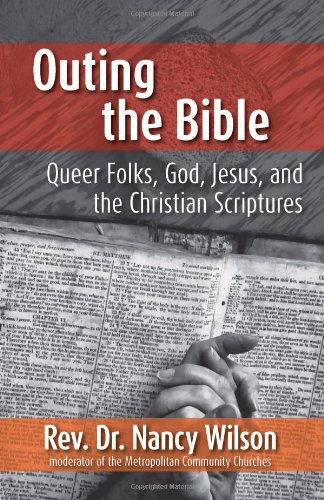
[4] Natalie K. Watson, Feminist Theology, Guides to Theology (Grand Rapids, MI: Wm. B. Eerdmans Publishing Co., 2003), 56–57.
[5] Rev. Dr. Nancy Wilson, Outing the Bible: Queer Folks, God, Jesus, and the Christian Scriptures, ed. Grant E. Mable (Indianapolis, IN: LifeJourney Press, 1995), 53.
[6] Wilson, 53.
[7] Wilson, 55.
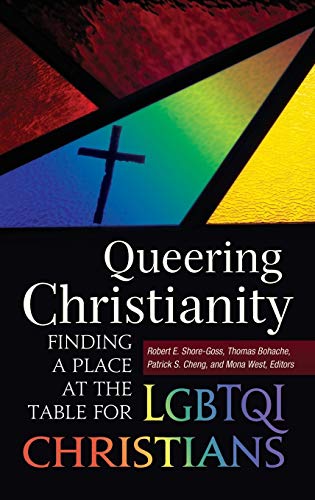
[8] Robert E. Shore-Goss et al., eds., Queering Christianity: Finding a Place at the Table for LGBTQI Christians (Santa Barbara, CA: ABC-CLIO, LLC, 2013), 372.
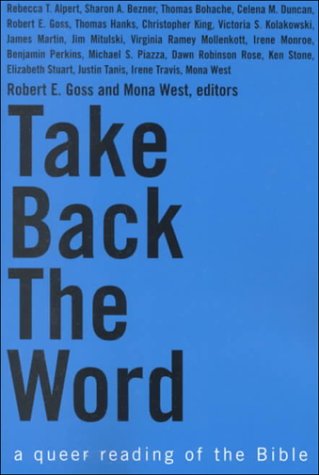
[9] Robert E. Goss and Mona West, eds., Take Back the Word: A Queer Reading of the Bible (Cleveland, OH: Pilgrim Press, 2000), 38.
[10] Mona West, “Outsiders, Aliens, and Boundary Crossers: A Queer Reading of the Hebrew Exodus,” in Take Back the Word: A Queer Reading of the Bible (Cleveland, OH: Pilgrim Press, 2000), 115.
[11] Goss and West, Take Back the Word: A Queer Reading of the Bible, 279.
[12] Ed Oxford, Has “Homosexual” always been in the Bible?, interview by Justin Hershey, Forge, March 21, 2019, https://www.forgeonline.org/blog/2019/3/8/what-about-romans-124-27.
[13] Wilson, Outing the Bible: Queer Folks, God, Jesus, and the Christian Scriptures, 51.
[14] Oxford, Has “Homosexual” always been in the Bible?
[15] Oxford.
[16] Goss and West, Take Back the Word: A Queer Reading of the Bible, 302.
[17] Wilson, Outing the Bible: Queer Folks, God, Jesus, and the Christian Scriptures, 114.
[18] West, “Outsiders, Aliens, and Boundary Crossers: A Queer Reading of the Hebrew Exodus,” 116.
[19] Elizabeth Stuart, Just Good Friends: Towards a Lesbian and Gay Theology of Relationships (London: Mowbray, 1995), 135.
[20] Wilson, Outing the Bible: Queer Folks, God, Jesus, and the Christian Scriptures, 117.
[21] Wilson, 117.
[22] Wilson, 119.
[23] Stuart, Just Good Friends, 136.
[24] Wilson, Outing the Bible: Queer Folks, God, Jesus, and the Christian Scriptures, 120.
References/Bibliography
Goss, Robert E., and Mona West, eds. Take Back the Word: A Queer Reading of the Bible. Cleveland, OH: Pilgrim Press, 2000.
Kim, Grace Ji-Sun, and Susan M. Shaw. Intersectional Theology. Minneapolis: Fortress Press, 2018.
Oxford, Ed. Has “Homosexual” always been in the Bible? Interview by Justin Hershey. Forge, March 21, 2019. https://www.forgeonline.org/blog/2019/3/8/what-about-romans-124-27.
Shore-Goss, Robert E., Thomas Bohache, Patrick Shu-Hsiang Cheng, and Mona West, eds. Queering Christianity: Finding a Place at the Table for LGBTQI Christians. Santa Barbara, CA: ABC-CLIO, LLC, 2013.
Stuart, Elizabeth. Just Good Friends: Towards a Lesbian and Gay Theology of Relationships. London: Mowbray, 1995.
Watson, Natalie K. Feminist Theology. Guides to Theology. Grand Rapids, MI: Wm. B. Eerdmans Publishing Co., 2003.
West, Mona. “Outsiders, Aliens, and Boundary Crossers: A Queer Reading of the Hebrew Exodus.” In Take Back the Word: A Queer Reading of the Bible, 106–18. Cleveland, OH: Pilgrim Press, 2000.
Wilson, Rev. Dr. Nancy. Outing the Bible: Queer Folks, God, Jesus, and the Christian Scriptures. Edited by Grant E. Mable. Indianapolis, IN: LifeJourney Press, 1995.
 BRIT LAVERGNE